Building a Career in Clinical Research: Why a PG Diploma and the Right Training Make All the Difference
Clinical research is no longer a niche field tucked away in hospital basements — it’s one of the fastest-growing career paths in life sciences today. Every new drug, vaccine, medical device, and therapy that reaches a patient has to pass through a structured chain of clinical trials, and behind every trial sits a team of trained professionals making sure it’s conducted safely, ethically, and accurately. For science, pharmacy, nursing, and life sciences graduates wondering what comes next after their degree, a PG Diploma in Clinical Researchor an industry-recognized certification program has become one of the most direct routes into this growing industry. But here’s the part most people underestimate: it isn’t the diploma certificate itself that gets someone hired. It’s the training behind it.
Why Clinical Research Is Attracting So Many New Graduates
The clinical trials industry has expanded rapidly over the last decade, driven by rising chronic disease burden, an aging global population, and a steady increase in outsourced trial work through Contract Research Organizations (CROs). Monitoring-related roles alone are projected to grow significantly faster than the average occupation over the next decade. At the same time, staffing shortages are a documented, real problem — a large share of major academic and cancer research centers report delays caused by a lack of trained coordinators and associates.
This creates a genuine opportunity: demand for skilled clinical research professionals is currently outpacing the supply of people who are actually job-ready. A basic life sciences degree gives someone the subject knowledge, but it rarely teaches the practical, tool-based skills that a CRO or pharma company expects on day one. That gap is exactly what a good PG Diploma or certification program is designed to close.
PG Diploma vs. Certification: What’s the Real Difference?
Both paths lead toward the same industry, but they differ in depth and time commitment. A PG Diploma in Clinical Research (PGDCR) typically runs 12 months along with internship, covering the full breadth of the field — trial design, regulatory affairs, pharmacovigilance, data management, and biostatistics — along with a structured internship component. A certification program, by contrast, is usually shorter and more focused, ideal for someone targeting a specific role like Clinical Data Management or Pharmacovigilance rather than the entire clinical research landscape.
Neither path is inherently “better” — the right choice depends on whether someone wants broad exposure before choosing a specialization, or already knows the specific role they’re aiming for. What matters more than the format is how much hands-on, practical training is built into the program, which is where many courses fall short.
The Clinical Research Career Path
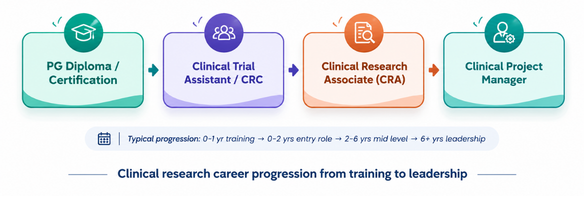
Most graduates enter the field as a Clinical Trial Assistant or Clinical Research Coordinator, working directly at hospital or trial sites. With two to three years of experience, the natural next step is a Clinical Research Associate role — monitoring trial sites on behalf of a sponsor or CRO. From there, professionals typically move into Clinical Project Management or specialize into Regulatory Affairs (RA), Pharmacovigilance (PV), or Clinical Data Management (CDM). The PG Diploma or certification is the entry ticket — everything that happens afterward depends on the quality of training received during that first step.
What Does a Clinical Research Organization (CRO) Actually Do?
Before going further, it helps to understand exactly what a CRO does — since most PG Diploma and certification graduates end up working inside one, or working with sponsors and sites that a CRO coordinates between. A CRO is essentially the operational engine that pharma and biotech companies outsource their clinical trials to, and its work is built around four core functional pillars:
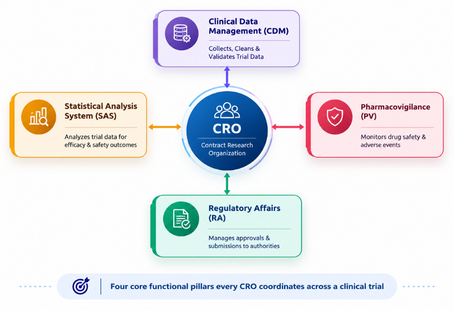
- Clinical Data Management (CDM) — collecting, cleaning, and validating every piece of trial data so it’s accurate and submission-ready.
- Pharmacovigilance (PV) — continuously monitoring participant safety and tracking adverse events throughout and after the trial.
- Regulatory Affairs (RA) — preparing and managing the approvals and submissions required by health authorities like the FDA, EMA, or India’s CDSCO.
- Statistical Analysis System (SAS) — analyzing trial data using specialized statistical software to determine efficacy and safety outcomes that ultimately support (or reject) a drug’s approval.
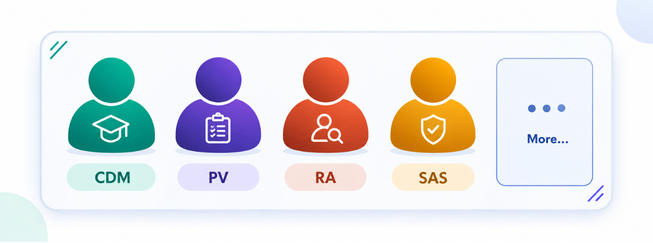
Almost every role discussed in this guide — CRC, CRA, Clinical Project Manager — ultimately feeds into or coordinates with one of these four pillars. This is also why most PG Diploma programs are structured around exactly these four specializations: they map directly onto how the industry itself is organized.
What a Good PG Diploma Program Actually Covers
A well-structured clinical research program goes well beyond textbook theory. Core academic content typically includes: Good Clinical Practice (GCP) and ICH guidelines — the ethical and procedural backbone of every trial
- Clinical trial phases and design — understanding how Phase I through Phase IV trials differ in purpose and structure
- Regulatory affairs (RA) — how trials get approved and how submissions work with bodies like the FDA, EMA, or India’s CDSCO
- Pharmacovigilance (PV) — drug safety monitoring and adverse event reporting
- Biostatistics and data management (CDM) — how trial data is collected, cleaned, and analyzed, often using Statistical Analysis System (SAS) software for outcome analysis
This academic foundation matters, but on its own, it isn’t enough to make someone employable. That brings us to the part that actually determines whether a graduate gets hired.
Why Training Is the Real Differentiator

This is worth saying plainly: the single biggest factor separating aspirants who get hired from those who don’t isn’t the diploma title — it’s the quality and depth of practical training behind it. Employers aren’t primarily looking for someone who can define “Good Clinical Practice” in an exam. They’re looking for someone who has actually touched an EDC system, filled out a mock case report form, and understands what a monitoring visit looks like in practice.
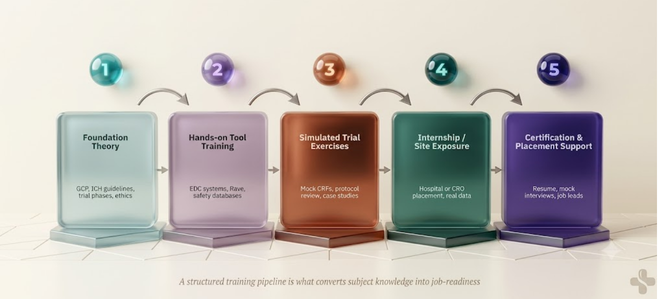
A strong training pipeline generally moves through five stages. It starts with foundational theory — GCP, ethics, and trial phases — but quickly transitions into hands-on tool training, where aspirants get real exposure to the electronic data capture (EDC) systems, safety databases, and clinical trial management software that CROs and pharma companies actually use day to day. This is where many programs fall short — teaching the theory of data management without ever letting a student touch the tools they’ll be expected to use immediately after hiring.

The next stage, simulated trial exercises, is where training starts to feel like the real job: mock protocol reviews, practice case report forms, and structured case studies that mirror actual trial scenarios. This is followed by internship or site exposure — ideally a real placement at a hospital, CRO, or pharma company, where aspirants work with live (properly anonymized) trial data and shadow experienced coordinators or associates. This stage is often what separates a resume that gets shortlisted from one that doesn’t, since it gives candidates something concrete to speak about in interviews beyond classroom learning.
The final stage — certification and placement support — is where a strong program continues investing in the aspirant even after coursework ends: resume building specific to clinical research roles, mock interviews with realistic technical questions, and direct connections to hiring companies. Programs that stop at “here’s your certificate, good luck” leave graduates to figure out the job search alone, right at the point where guidance matters most.
Skills Employers Actually Look For
Beyond subject knowledge, recruiters in this field consistently prioritize a specific set of practical skills: familiarity with EDC platforms like Medidata Rave or Oracle Clinical, working knowledge of safety databases such as Oracle Argus, attention to detail in documentation, and — increasingly — the ability to work with data management and reporting tools with confidence rather than hesitation. Soft skills matter just as much: clear communication for coordinating between sites, sponsors, and regulatory bodies, and the ability to handle sensitive patient and trial data with strict confidentiality. A training program that builds these skills through repetition and real tool exposure, rather than just describing them in a lecture, produces far more job-ready graduates.
Choosing the Right Institute
Given how much the training component matters, the choice of institute deserves real scrutiny — not just brand recognition. A few things worth checking before enrolling: whether the program is accredited by a recognized body (in India, look for LSSSDC, NSDC, or NCVET accreditation), whether the curriculum includes actual hands-on software training rather than purely theoretical coursework, whether an internship or site-exposure component is built in rather than optional, and whether the institute offers structured placement support rather than just course completion.
Institutes like BCRI (Bangalore Clinical Research Institute) are a useful example of this model in practice — offering government-accredited programs across Clinical Research, Clinical Data Management (CDM), Pharmacovigilance (PV), Regulatory Affairs (RA), and Clinical SAS (Statistical Analysis System),built specifically around hands-on tool training, internship placements, and dedicated placement support rather than theory alone. The specific institute matters less than confirming these four elements exist in whichever program you’re considering.
Getting Started

A PG Diploma or certification in clinical research can genuinely open the door to a growing, meaningful career — one where the work directly contributes to new treatments reaching patients. But the credential itself is only the starting point. What actually determines whether that door opens is the quality of hands-on training behind it: real tool exposure, simulated trial practice, genuine internship experience, and structured support in translating that training into a first job offer.
For life sciences, pharmacy, nursing, and biotechnology graduates specifically, this is one of the more accessible entry points into a global industry — the foundational subject knowledge from a bachelor’s degree already covers much of the scientific groundwork; what’s missing is usually just the applied, tool-based layer that a good diploma program is built to provide. The earlier that gap is closed after graduation, the sooner a candidate can start building the years of practical experience that senior roles eventually require.
For any aspirant evaluating programs, that’s the question worth asking first — not “what will I learn,” but “what will I actually be able to do by the end of this.”