If a Principal Investigator is the doctor leading a study, the Clinical Research Coordinator (CRC) is the person making sure every moving part of it happens on time, correctly, and within the boundaries the protocol sets. It is, in the truest sense, an operations role — except the “operations” are a patient's safety, a sponsor's data, and a regulator's trust, all at once.
The Person Who Makes a Clinical Trial Actually Run
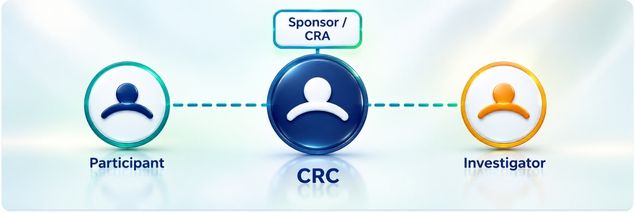
A CRC sits at the centre of a small but demanding network: the participant who needs care and clarity, the investigator who needs accurate information to make clinical decisions, and the sponsor or CRA who needs clean, auditable data. Very little of that work is glamorous. Almost all of it is essential.
India's position in this picture has changed considerably over the last decade. As global sponsors and CROs expand their footprint here — drawn by a large patient pool, skilled investigators and lower operating costs — the demand for coordinators who can run trials to international GCP standards has grown with it. That demand is exactly why the role rewards people who take their entry into it seriously, rather than treating it as a stopgap job.
The core responsibilities
- Recruitment & screening — identifying participants who genuinely meet a study's eligibility criteria, without over- or under-selling the trial.
- Informed consent — explaining a study in plain language, checking real understanding, and documenting it correctly, every time.
- Visit coordination — scheduling assessments, collecting samples, running questionnaires, and keeping every visit on protocol.
- Source documentation — keeping records accurate and audit-ready, the paper trail a trial's credibility rests on.
- Safety reporting — spotting and escalating adverse events promptly, with no ambiguity in the record.
- Cross-team liaison — the daily connective tissue between investigator, sponsor, ethics committee and lab.
It's a role that blends clinical familiarity, regulatory awareness, meticulous documentation and real people skills — often within the same hour. That range is exactly why the role is both harder than it looks from the outside, and a genuinely strong foundation for a long career in clinical research.
A Trial, Coordinated: The Daily Workflow
Textbooks describe Good Clinical Practice in the abstract. In a live study, it plays out as a sequence — the same loop repeating for every single participant, dozens or hundreds of times across a trial's life:
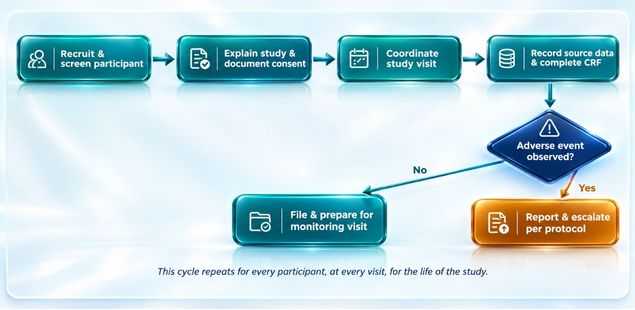
Notice what this loop rewards: precision under repetition. A Clinical Research Coordinator (CRC) who can run this cycle cleanly, visit after visit, without letting fatigue erode documentation quality, is the kind of coordinator every site wants to keep. It is a skill built almost entirely through practice — which is the thread running through the rest of this article.
Why Structured Training Is the Non-Negotiable Starting Point
A CRC role touches regulation, ethics, clinical procedure and data integrity at the same time, and none of that is intuitive on day one. Formal training exists to compress years of “learning the hard way” into a few focused months, covering the frameworks a coordinator is expected to already know before they ever meet a real participant.
What good training actually builds
- Regulatory fluency — ICH-GCP guidelines, Schedule Y and the New Drugs and Clinical Trials Rules in the Indian context, and how ethics committees expect a study to be run.
- Documentation discipline — the difference between a source document and a case report form, and why the gap between them is exactly what auditors look for.
- Informed consent as a skill, not a form — explaining risk and purpose to someone who isn't clinically trained, in language they genuinely understand.
- Safety judgement — recognising when something is reportable, and how fast it needs to move once it is.
- The sponsor–site relationship — what a CRA is checking for during a monitoring visit, and how to be ready for it rather than caught by it.
Why this matters more than it might seem: a CRC who has never been trained on GCP doesn't just work slower — they can genuinely put a study's data integrity, and a participant's safety, at risk without realising it. Training is what turns good intentions into reliable practice.
It's also worth treating training as an ongoing credential rather than a one-time course. Recognised certifications signal to employers that your knowledge is current, not just historical. In a field where guidelines are periodically updated, staying certified is part of staying employable.
Choosing the right certification path
Institutes such as Bangalore Clinical Research Institute (BCRI) offer combination of a foundational Certification in Clinical Research, an Advanced Diploma in Clinical Research (ADCR), or a Post Graduate Diploma in Clinical Research (PGDCR) — each pitched at a different starting point and career depth. A shorter certification is often enough to enter the field as a CRC, while the ADCR and PGDCR go deeper into regulatory affairs, biostatistics and Clinical Data Management, better preparing candidates for CRA-track roles or specialised functions later on. Whichever level of Clinical Research Training you choose, look for a programme that treats classroom learning as inseparable from hands-on site exposure — the internship argument made throughout this article applies to every one of these qualifications.
But training has a ceiling. A course can teach you what informed consent requires; it cannot fully prepare you for the participant who is anxious, unclear, or reluctant to sign anything in front of you. That gap — between knowing the rule and applying it under real conditions — is precisely what an internship is for, where Bangalore Clinical Research Institute (BCRI) plays major role.
The Internship: Where a Certificate Turns Into a Career
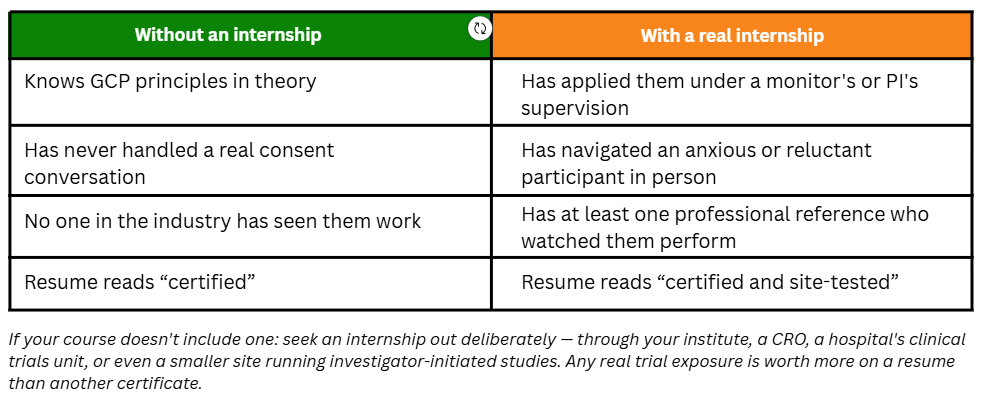
Here's something students are rarely told plainly enough: a CRC certificate proves you understand the theory. It does not prove you can walk into a site and actually coordinate a live trial. That gap is exactly what a structured internship closes — and it's the single biggest factor separating a strong resume from an employable one.
It's where the real learning happens
No classroom simulation replicates the pressure of a monitor questioning why a source document doesn't match a CRF entry, or a participant missing a visit window at the worst possible time. An internship is where you develop judgement — not just knowing the rule, but knowing how to apply it when the situation is messy.
Employers actively filter for it
Most CROs and hospital-based research units treat “zero months of site experience” as a real hiring barrier, regardless of how strong a candidate's course marks were. An internship — even two or three months — is what moves a resume from “trained” to “hire-ready” in a recruiter's eyes.
It builds your network before you need one
The investigator, coordinator or CRA you intern under is very often the person who either hires you directly afterward, or refers you to someone who does. In clinical research more than most fields, a first job tends to arrive through someone who has already watched you work under pressure.
It tells you which side of the field you actually enjoy
Some interns discover they love the participant-facing, on-the-ground coordination side of the work — the CRC track. Others realise they're drawn to the cross-site, audit-and-oversight side of things, which tends to point toward a CRA role later. Either way, this is something you learn by doing the job, not by reading about it.
Where the CRC Role Can Take You
One of the most attractive things about starting as a CRC is that it isn't a dead end — it's a launchpad. A fairly well-defined ladder exists in Indian clinical research, and most people climb it by adding experience, certifications and progressively wider responsibility.
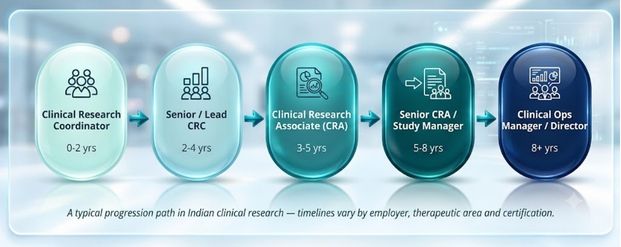
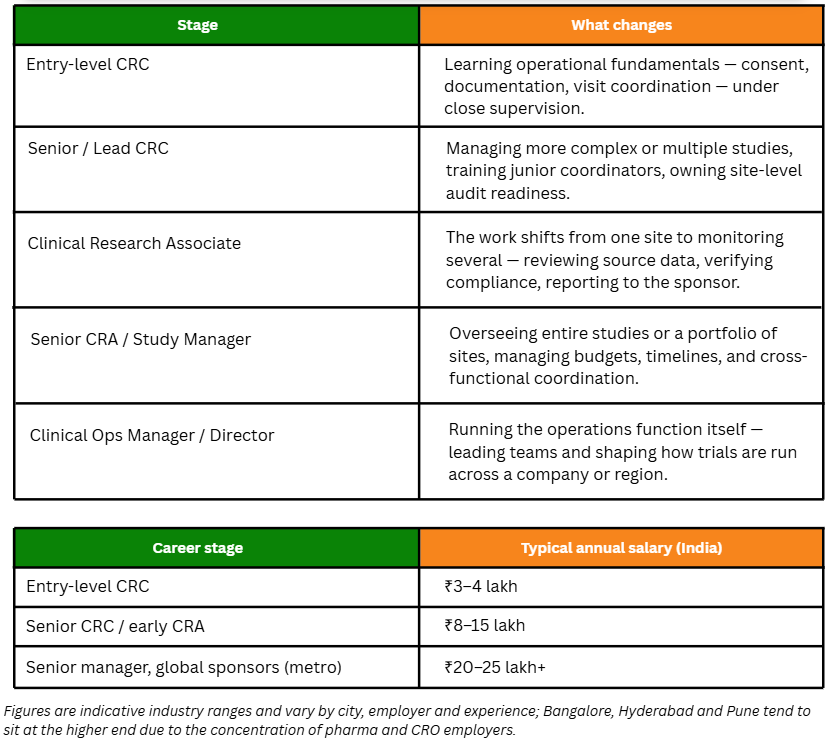
What makes this ladder attractive isn't just the pay growth — it's the shape of the career itself. Clinical research offers a structured path with global exposure, cross-functional skill-building, and a clear sense of what the next step looks like, which is rarer than it should be in entry-level healthcare-adjacent roles.
What Separates a Good CRC From a Great One
Beyond the certificate and the internship, a handful of habits tend to define the coordinators who move up fastest. None of these show up on a transcript, but every experienced site manager or CRA will tell you they're what they actually notice in someone's first few months on the job:
- Meticulous documentation
- Calm under audit pressure
- Plain-language communication
- Protocol discipline
- Proactive safety reporting
- Time management across visits
- Comfort with EDC & eTMF systems
- Genuine participant empathy
None of these are exotic. All of them are trainable — and all of them are far easier to build with real trial exposure than without it.
The Bottom Line
A CRC role is rarely glamorous in its first year. It's detail-heavy, documentation-heavy, and demanding in ways a course description doesn't quite capture. But it's also the fastest, most direct route into a clinical research career that offers genuine long-term growth, global exposure through CRO and sponsor work, and a progression path most other entry-level roles simply don't offer.
Training gives you the knowledge. The internship gives you the credibility. What you do with both is what determines how quickly you climb the ladder above.
Ready to move from theory to practice? BCRI's Certification in Clinical Research, Advanced Diploma in Clinical Research (ADCR) and Post Graduate Diploma in Clinical Research (PGDCR) programmes pair structured GCP Clinical Research Training with real site internships — the combination this article makes the case for. Reach out to our team to find the right track for you.